Scaling up to create impact
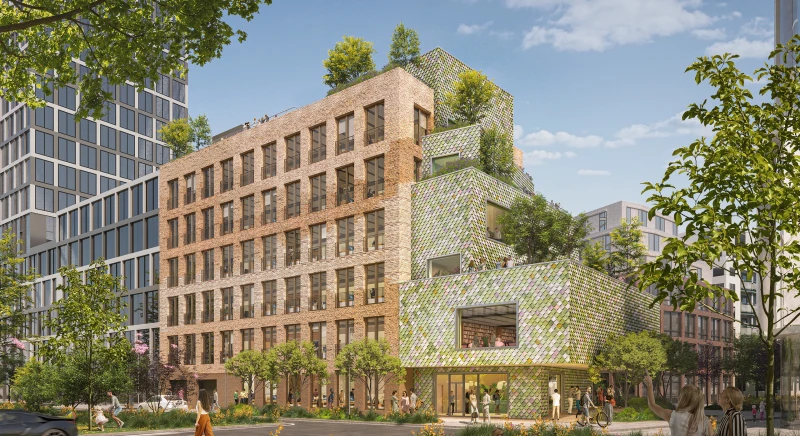
How do you turn a design experiment into a product that contributes to change on a large scale? To make a real impact, change needs to happen at scale. For designer Hester van Dijk of Overtreders W, this was an important lesson from working on temporary architecture, such as pavilions and exhibitions. The global plastic problem is simply too big to be solved through small-scale applications. The question therefore became: how can waste be turned into a building material that can be applied on a large scale?
From waste to building material
At the beginning of 2015, designers Reinder Bakker and Hester van Dijk of Overtreders W, together with architect Peter van Assche of bureau SLA, came across a shipping container filled with household plastic waste. They became fascinated by the material’s hidden beauty and potential. Could a discarded shampoo bottle be given a new and better life as a valuable building product?
The idea grew into the Pretty Plastic Plant. Using their own sorting system, washing machine, shredder and injection moulding machine, they explored how different types of plastic could be processed. This proved more complicated than expected: household plastic consists of different material streams, such as PET, HDPE, LDPE and PP, and comes in a wide range of colours.
By sorting and processing the waste themselves, they created the first façade tiles. More than a thousand distinctive tiles were produced and used in various interior projects. In 2016, the designers presented their material during Dutch Design Week.
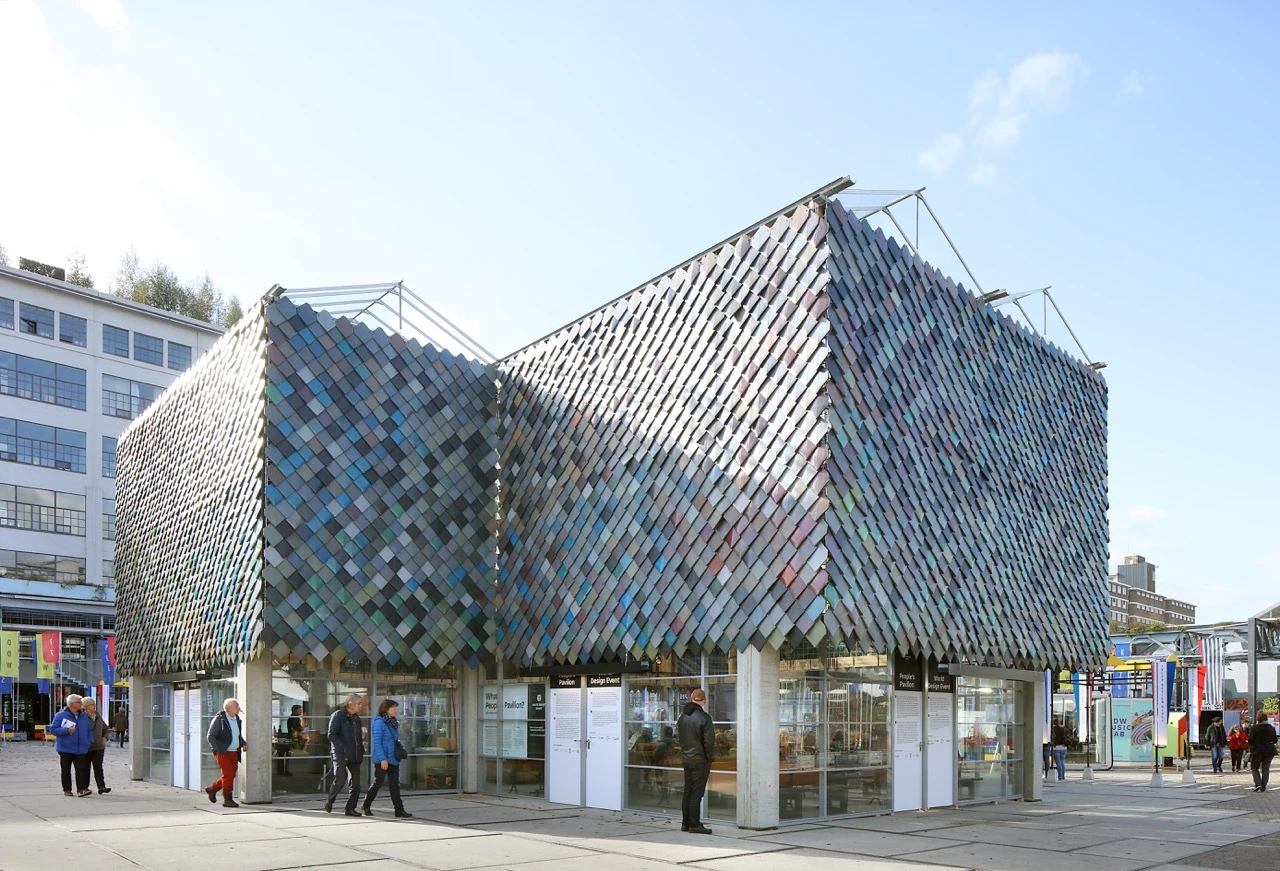
A year later, a much larger test followed: the People’s Pavilion at Ketelhuisplein during Dutch Design Week 2017. For this circular building, which could accommodate 350 people, 9,000 unique façade tiles were made from 100% recycled household plastic waste. The pavilion not only demonstrated that waste plastic can have aesthetic value, but above all that it can also function as a usable raw material for construction.
From experiment to product
There was a great deal of interest from the architecture world. Architects wanted to use the material in their own projects. This created a new challenge: how do you turn a temporary experiment into a building product suitable for permanent structures?
This proved to be a much bigger step than simply designing an attractive prototype. Permanent buildings have to meet strict technical and legal requirements. One of the biggest obstacles was fire safety. The original mix of household plastics did not meet the requirements for permanent construction.
The team had to go back to the drawing board. After a development process of approximately two years, they opted for recycled PVC. This material stream is inherently more fire-resistant and made it possible to obtain the required Class B fire certification.
International scaling also brought new challenges. European countries use different testing methods and regulations, meaning that a product certified in one country cannot automatically be used everywhere.
From design studio to company
The technical breakthrough made it clear that production on this scale could no longer be carried out alongside the regular work of a design studio. What had started as a side project had grown into a serious business.
In 2020, Pretty Plastic was therefore established as an independent limited company. The founders deliberately chose a division of responsibilities: as shareholders, they remain responsible for the creative and sustainable direction, while a specialised team focuses on day-to-day operations and sales.
This professionalisation was necessary to take the next step: turning a promising design into a product capable of generating real volume in the construction sector.
Design as a driver of systemic change
Pretty Plastic’s mission has remained the same: to use waste as a high-quality raw material, without compromising its circularity. The company deliberately avoids collaborations in which, for example, the material is diluted or made less recyclable in order to reduce costs.
This design choice also determines how Pretty Plastic approaches growth. The tiles are now supplied internationally from the Netherlands, but the company is also exploring opportunities for local production on other continents. By producing closer to both the source of the waste and the market, transport emissions can be reduced and the positive environmental impact can be increased further.
Pretty Plastic is therefore not only about creating a circular product. Design is the starting point for a broader change in the way we think about waste, raw materials and construction.
Inmiddels is Pretty Plastic de experimentele fase ver voorbij:
- 350,000+ kg PVC waste
- Processed and given a new life
- 15,000+ m² of façade cladding
- Sold and installed
- 12
- Tile colours
Pretty Plastic demonstrates that design does not have to end with a prototype. By continuing to design, test, adapt and professionalise, a material experiment can grow into a product and a company that genuinely brings about change at scale.
“The problem of plastic waste is so big that you have to solve it with a product that can be produced at real volume.”