Conversation Starters for Effective Collaboration

How aware are you of your own language and worldview — and of those of your collaboration partners? Use the comics and conversation games by ONT & AMBT to start the conversation.
What:
12 comics by ONT & AMBT and 3 conversation games
Who is it for:
Designers and civil servants who want to collaborate more effectively.
How to use it:
Use the comics as conversation starters in presentations or at project kick-offs and other meetings, or put them up around the office. Please credit Fides Lapidaire and PONT as the creators. The conversation games can be used both at the start of a collaboration and throughout the process.
Comic series: ONT & AMBT join forces
More and more designers are working with or within government on societal challenges. This is already producing valuable results in many places across the Netherlands, but it also brings challenges. Commissioned by PONT, social designer Fides Lapidaire explored how designers and civil servants work together. She spoke to professionals who know how to find each other around shared challenges, but who can also sometimes get lost in each other’s worlds and ways of working. She brought her insights together in the ONT & AMBT comic series.
“Language can build bridges between worlds, but it can just as easily create barriers.”
Three conversation games to play with your collaboration partners:
Association Game
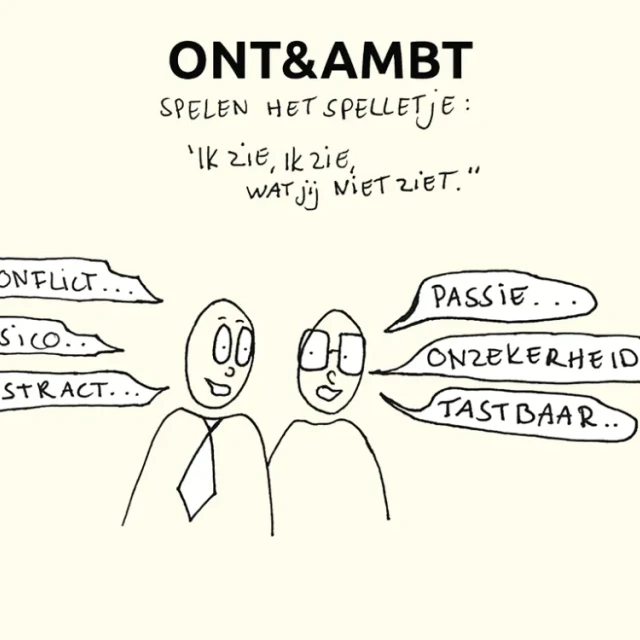
Sometimes you mean the same thing but use different words. Sometimes you use different words but mean the same thing. What meaning do you attach to ‘vague’ terms? Fides Lapidaire created this list of words to explore the associations designers and civil servants have with them. The differences in their answers led to valuable conversations and provided insight into each person’s perspective.
Try playing an association game with the people you work with. Use this list, or create your own list of terms that are commonly used within your organisations. Take turns sharing a term and have everyone privately write down the first word that comes to mind. Then share your associations with each other. Where do they overlap, and where do your interpretations differ?
I Spy: What Do You See That I Don’t?
A person’s worldview is strongly shaped by their experiences, background and education. Where one person sees weeds, another sees biodiversity. Where one person experiences a nuisance, another sees opportunities for the neighbourhood. What feels rustic to one person may look untidy to another. By discovering someone else’s associations, you gain a unique insight into the way they think. This is useful when exploring your target group, but also when trying to better understand your collaboration partner.
Next time you go for a walk together, ask the other person to spend five minutes telling you what they see and what comes to mind.
Technical Language or Vague Language? Draw It!
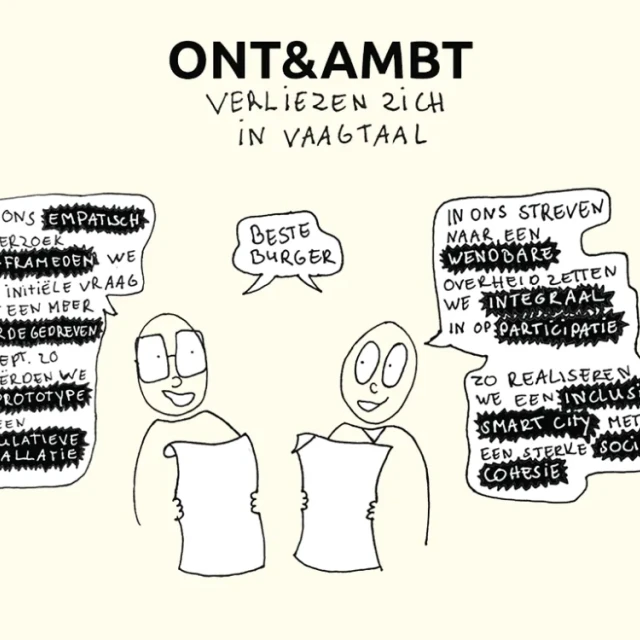
Language can reveal as much as it can conceal. Words help us communicate accurately and clearly about a field of expertise, but they are sometimes used without actually saying very much. No one is likely to disagree with them, but it is difficult to challenge them either. This is what can turn technical language into vague language. Before you know it, you are saying the same thing but meaning something different.
Try playing ‘Draw It!’ with your collaboration partners, using technical terms you often use. What does integrated or value-driven actually look like? Visualising words helps make them more concrete.
This tool grew out of a research project that started with the question: ‘How can designers and professionals working in the public sector become more aware of both their own language and the language of others, so that both parties are better equipped to work together?’ Designer Fides Lapidaire was selected to explore this question through the research.
Downloads
- The ONT&AMBT comics (NL)51.89 MBDownload