A society in which more people can participate
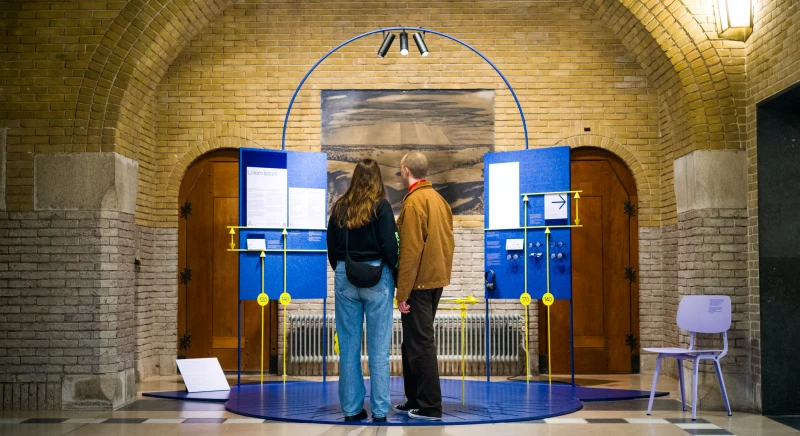
How do we design a society in which more people can participate? Inclusion is not a problem that can be solved once and for all. It requires continuous learning, unlearning and adaptation. Between 2023 and 2025, the Dutch Ministry of Health, Welfare and Sport (VWS), the Ministry of Education, Culture and Science (OCW) and Dutch Design Foundation explored how design can contribute to a more accessible, diverse and inclusive society.
The starting point was the recognition that much of our environment, systems and ways of working are still designed around a limited norm. Inclusion therefore requires more than solutions for specific groups; it calls for a different way of looking and designing. Which perspectives do we include? What assumptions do we make? And how do we ensure that people can genuinely participate?
Over time, the focus of the challenge shifted. In 2023, the emphasis was on inclusion as a practice: learning to see from different bodies, experiences and perspectives. In 2024, the programme explored how inclusive design practices can become part of an ongoing process. In 2025, the focus shifted towards how accessibility, diversity and inclusion can also become a structural part of policymaking.
Inclusion was therefore not approached as an end point, but as a design practice: a continuous process of learning, testing, reflecting and adapting.
To explore a challenge like this, no single perspective is enough. That is why the Embassy of Inclusive Society brought together different worlds: designers, people with lived experience, policymakers, cultural institutions and societal partners.
The collaboration between VWS, OCW and Dutch Design Foundation formed the foundation of the three-year programme. Around it, a broader coalition emerged of designers, makers, organisations and communities who contributed to the research through their own expertise and experience.
The collaboration took different forms. During Dutch Design Week, exhibitions and installations served as public testing grounds. Workshops brought designers, communities and people with lived experience together around concrete questions from practice. Conferences created space for reflection and dialogue. And through design research, the programme explored how insights from practice could feed into organisations and policy.
An important principle throughout was not to design for people, but with people. For example, practically educated young people were involved in developing ideas around health-related issues in Brabant Gaat Beter. In the collaboration between ST-DUO and dance company Misiconi, visual and non-verbal tools were developed based on the dancers’ own practices and experiences.
The Embassy itself also became part of the experiment. Volunteers from organisations including Philadelphia Zorg and Cello contributed to the programme. Inclusion thus became more than a topic of discussion: it became something to practise within the organisation and the visitor experience itself.
The three-year collaboration did not produce a blueprint for an inclusive society. That, in itself, is an important outcome: inclusion requires an ongoing practice of learning, unlearning, experimenting and adapting.
Over the years, the programme generated a range of concrete interventions, methods and insights. The Gym by Gabriel Fontana made inclusivity something to practise, quite literally. Lorem Ipsum translated guidelines for inclusive presentation into a spatial experience. The Vraagje?! campaign became an interactive installation during DDW24, inviting visitors to engage in conversations about accessibility themselves.
Another outcome was the publication Events as Learning Cycles, which translated the knowledge gained around inclusive events into transferable principles and practical tools. Professionals and organisations subsequently used the publication as inspiration for developing more inclusive events.
In 2025, the knowledge gained was brought into the realm of policymaking. The design research project Designing Inclusive Policy resulted in three future scenarios – The Questioner, The Reflection Space and Policymaking in the Country – as well as ten concrete perspectives for action for policy organisations. These include structurally involving people with lived experience, creating space for reflection, valuing different forms of knowledge, and embedding inclusion in leadership and organisational culture.
The Embassy thus evolved from making inclusion visible to developing new ways of putting inclusion into practice. From exhibition to testing ground, from experiment to shared design practice, and ultimately from design practice to policy challenge.
Perhaps the most important outcome, then, is not a single solution, but a different way of working: inclusion as something we design, explore and continuously learn together.
Will you think along with us?
Do you have a challenge around inclusion that calls for a different approach?
Plan a conversation